Why women can’t afford to ignore the AI revolution
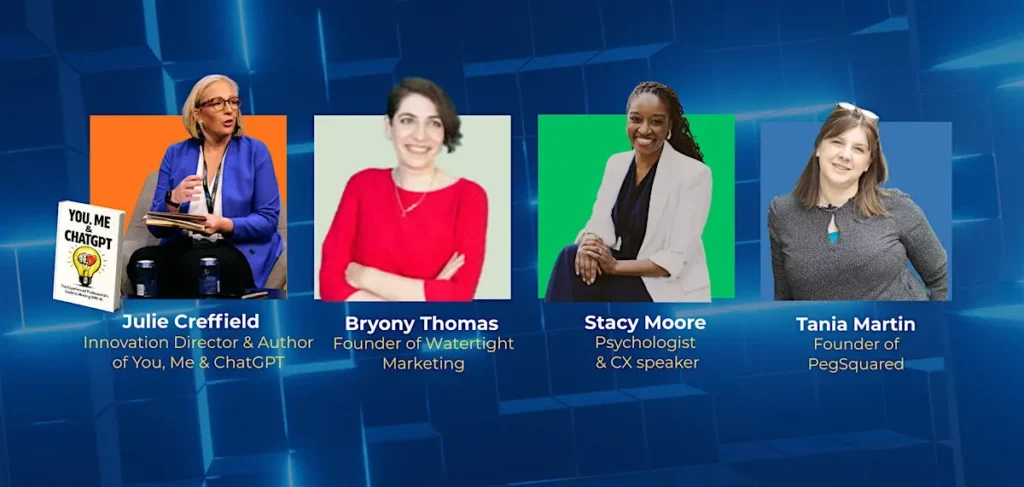
Last week, something rather refreshing happened. A room full of people sat down together at the Theobalds Enterprise Centre in Cheshunt, right next door to the Google data centre, and had an honest conversation about artificial intelligence. Not a jargon-heavy lecture that you find at tech conferences, but a real, grounded discussion about what AI actually means for our working lives, our businesses, and our future.
The event, hosted by Broxbourne Enterprise Centres, brought together professionals from a range of backgrounds – from skeptics to integrators – to explore the value of AI and how we might, or might not, be using it. And the questions people asked spoke volumes about where we really are with this technology.
“Am I even allowed to use AI? Is it cheating?”
This was one of the questions posed during the panel discussion, and it landed with a ripple of recognition around the room. It’s a question many of us have quietly wondered but perhaps not dared to say aloud. The answer is of course you can use AI, depending on your employer’s policies, your industry’s guidelines, and the nature of the task. But the fact that so many people feel uncertain about this tells us something important. We’re at a moment where the rules are still being written. Is it ethical to use AI to answer your customer’s questions? To create a slide deck or analyse data? To create a weekly meal plan for a family with different dietary requirements? It’s particularly relevant for those who are less confident about using AI in the first place.
The gender gap nobody’s talking about
It’s well documented that fewer women than men work in technology. But the AI adoption gap goes further than that. Research consistently shows that women are less likely than men to be using AI tools, whether that’s in their professional lives or at home. The reasons are nuanced: lack of confidence with new technology, fewer role models, less encouragement to experiment, and sometimes simply not seeing AI as something that’s “for them.” Julie shared a McKinsey survey that shows that only 21% of women in entry level roles in the US/Canada are encouraged to use AI at work, compared to 33% of men in similar roles. (Women in the Workplace 2025, December 2025). This is important as when employees are encouraged to use AI, they’re over 50% more likely to do so, allowing them to build essential skills.
The risk, as was openly discussed at the event, is that women could be left behind. Not through any fault of their own, but because the people shaping how AI is used, in businesses, in hiring, in everyday products, are predominantly those who are already using it. If women aren’t at the table, their needs, perspectives, and voices won’t be built into the tools that will increasingly run our world.
The other side of the coin
Here’s where the conversation became particularly thought-provoking. Because whilst women may be slower adopters of AI, they are disproportionately represented in the roles most likely to be disrupted by it. Administration, customer service, data entry, HR, and many healthcare roles are all sectors with a high proportion of female workers, precisely the kinds of jobs that AI is already beginning to handle. Worryingly, almost 60% of jobs assessed as at risk of change from AI in London are filled by women, despite them making up just 45% of the city’s overall workforce. This is from a GLA report published on 28th April, 2026. It’s not a reason for alarm, but it is a reason for urgency.
“Should I use AI to strengthen my strengths, or help with my weaknesses?”
This question sparked a brilliant discussion. The honest answer is: both but perhaps start with your weaknesses. If writing doesn’t come naturally to you, use AI to help you draft and structure. If you struggle with data, let AI do the heavy lifting and create that table. Free yourself up to do the things you’re genuinely brilliant at. Over time, as your confidence grows, you’ll find AI amplifying your strengths too.
“How can we use AI to capture stories?”
This was perhaps the most imaginative question of the morning, and a reminder that AI isn’t just a productivity tool, it’s a creative one too. From preserving oral histories and documenting community voices, to helping small businesses tell their story in a compelling way, AI can help us capture and communicate human experience in ways that would previously have taken significant time and resources.
What happens now?
The message from the room was clear. The best way to protect yourself from being replaced by AI is to understand it, use it, and make it work for you. You don’t need a computer science degree, just curiosity and a willingness to experiment. Start small, ask the “silly” questions, and find your community.
AI is here. The question isn’t whether it will change the way we work, as it undoubtedly will, it’s whether we’ll be the ones steering it.
Interested in learning more? Speak to Julie Creffield, our Innovation Director and passionate adopter of AI. Read Julie’s latest book You, Me and ChatGPT: The. Experienced Professionals Guide to Working with AI to explores the psychological, professional and intellectual shifts happening beneath the surface of the AI boom.
The questions many professionals feel but rarely say out loud. It’s thought provoking but ultimately can help reposition how you approach AI.
As Julie says:
“AI does not replace expertise.
It exposes shallow thinking and amplifies depth.”
Join our monthly Coffee & AI Conversations Meet Up on Friday 15th May. Register here